
The Power of the Right Landing Page
Driving the right traffic is only part of a successful paid media strategy. Where that traffic lands can have just as much impact on performance.
Across two SaaS clients focused on growing monthly recurring revenue through free trials and demos, we tested how landing page selection impacted conversion performance.
In both cases, the data reinforced an important lesson: the most conversion-focused page isn't always the best-performing page. The right experience depends on user intent.
Client A: Matching the Page to Search Intent
For our first client, we tested moving paid search traffic from the company's primary website to newly created landing pages designed specifically for paid traffic.
The goal was to create a more direct path to conversion. But the results varied significantly between branded and non-branded traffic.
For non-branded campaigns, conversion rate declined from 2.6% before the test to 2.3% during it. We ultimately returned this traffic to the original website, where conversion rate increased to 3.2% - the highest of any period analyzed.

The broader website appeared to better serve users who were still learning about the product and weren't ready to immediately request a demo.
Branded traffic was different. These users were already demonstrating greater familiarity and intent, so we continued directing them to the dedicated demo page.
This told us: The same landing page strategy wasn't right for every audience.
Client B: When the Landing Page Becomes the Bottleneck
Our second client had been running a non-branded paid search campaign to a new landing page. After several months of struggling performance, we switched traffic back to the landing page experience we had historically used.
The impact was substantial.
Comparing the 30 days before and after the switch:
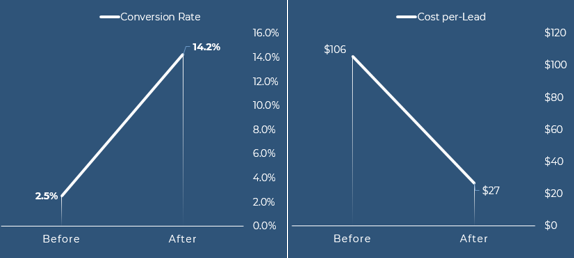
Conversion rate increased from 2.5% to 14.2%
Cost per conversion decreased from $106 to $27
Conversion volume increased from 596 to 16,806
That's a 5.6x increase in conversion rate and a 75% reduction in cost per conversion.
Investment increased significantly during the second period and bidding strategies evolved, so the landing page wasn't the only variable affecting total conversion volume.
But increased spend alone doesn't explain the efficiency improvement. Conversion rate increased by more than 460% while cost per conversion fell by approximately 75%, providing a strong indication that the previous landing experience had been limiting performance.
Digging Deeper
We continued analyzing landing page performance after the switch to understand what was driving the improvement.
From June through August, Page 1 accounted for approximately 49% of traffic but 91% of signup volume, with a 16.9% conversion rate.
Page 2, by comparison, converted at just 2.1%.

Page 1 wasn’t simply efficient - it could also scale. It generated nearly 19,900 signups during the analyzed period.
Most importantly, it closely matched what users were searching for. Visitors could immediately see a relevant use case for the product before naturally progressing into signup.
The Takeaway: Match the Landing Page to the User
Neither test suggests that traditional landing page best practices don't matter.
Regardless of the destination, the primary conversion action should still be prominent, easy to understand, and visible early in the experience - ideally above the fold.
What changes is the amount of information users need around that CTA.
A high-intent branded user may be ready to request a demo immediately. Someone arriving through a broader non-branded search may need product information, use cases, or proof points first.
The goal isn't to choose between education and conversion. It's to match the experience to user intent while making the next step unmistakably clear.
These tests also demonstrate why marketers shouldn't assume a new or purpose-built landing page will automatically outperform an existing experience. Test it, measure it, and let performance determine where each audience should land.
When user intent, landing page experience, and conversion path align, the result can be more than a higher conversion rate; it can create the efficiency needed to scale customer acquisition and ultimately grow the business.


